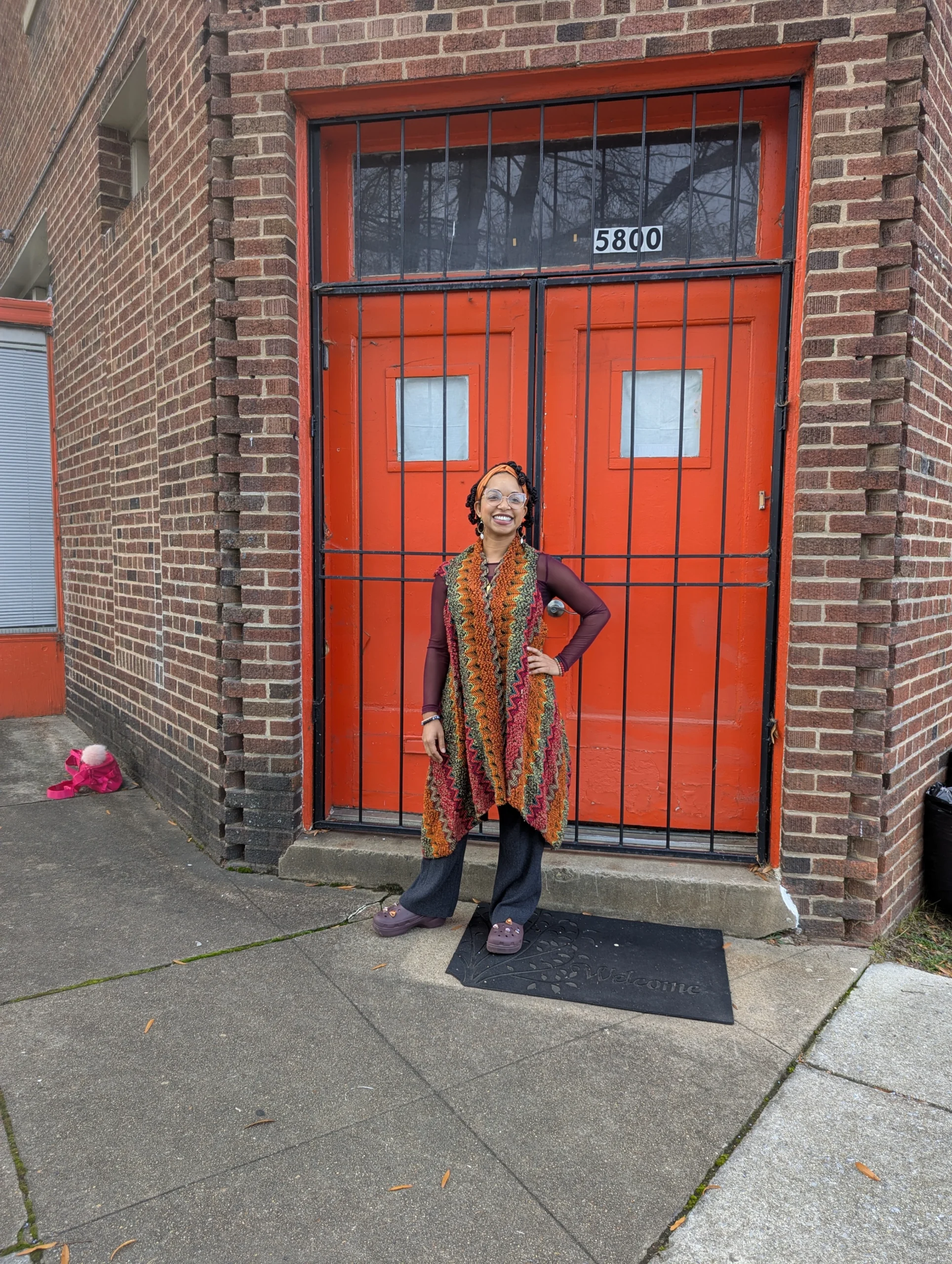
Chelsea Harrison standing in front of the 11 Nicholson Co-op's community room
Tell us a little bit about yourself and your background.
I am ChelseaDee Harrison. I am a theater maker. Anything it takes to tell a story to a group of people, that is what I do. I’m also a teaching artist. So I teach people how to use theater and how to use theater in unconventional ways in places that don’t involve a theater. So that’s another part of me. And I’m also an artivist. I’m interested in the intersection of art and activism. How can art and storytelling in particular help communities meet their needs?
So that’s a little bit about me. I was born and raised in Washington, D.C., moved away to New York City, spent a little bit of time in the Midwest, and really wanted to slow down a little bit, but also dig into my roots and really come to understand my own personal artistry. And so that’s what brought me home to DC, specifically to 11 Nicholson Street, where I still reside.
When you were looking to return to the DC area, what was that process like?
I always feel that this place is miraculous. It’s a miracle place for me because I was apartment hunting from Brooklyn and just googling like crazy, trying to figure out, where do you find affordable apartments? I just didn’t know all the ins and outs of it and I was doing it from another state. So when I came into town to check out some places, I mistook this apartment for the address of the leasing office for another building. And so I was knocking on the door, and fortunately, the maintenance man was in the hallway nearby, and he took me to the basement to find a leasing application and gave me all the information I needed.
I was able to apply and get the apartment. But it was really through happenstance. And I was looking for a space of my own, but wondering how I was going to afford that as an artist? So stumbling upon this place and its affordability, the space that it gave me, the independence that it gave me to work as a creative professional and be able to afford where I live really gives a sense of dignity and autonomy that brought me to DC.
What year was it that you moved back?
It was the end of 2019 and it turned out to be a few months before COVID emerged on the scene. And so I felt incredibly grateful to have stumbled onto some housing before having to be completely kind of pushed out of the public sphere, isolated, having to reinvent myself, figure out how I’m going to continue to do theater, you know, in a global pandemic. And so, yeah, having this place became even more crucial.
Were you able to connect with other people in the building during that time?
Oh, no, it was every unit for themselves. It’s truly the process of TOPA and the process of learning what to do when your building is being sold. That is when I met my neighbors. Up until that point, I was just knocking on the door outside, hoping that somebody was there. You know, I didn’t know anybody. And then living in New York City, I didn’t know my neighbors in New York city. I don’t know if I always wanted to know my neighbors in New York city. So, you know, I was used to this level of isolation that now I feel like, wow, how was I even surviving?
11 Nicholson Cooperative
When did the TOPA process start for you all?
I think it was 2022 when there was a notice, and I just remember being like, oh no, this is it. I don’t know what that document means, but there’s a document taped to the front door. That cannot be good. And so my assumption was naturally the sheriff is going to come and throw all our stuff onto the sidewalk in the coming weeks. And we’re being notified that we only have a few days to figure it out. I realize now that that assumption was probably from movies I saw growing up, or even just historical archives that I was in where you can see people’s belongings on the street in the 1930s, 1940s. I didn’t know what anything meant. I didn’t know that we had any rights as renters. They don’t tell you that you have rights. They don’t tell you that you can’t just be thrown out into the streets. Even if you’re being threatened with that, even if they’re sending you documents on official letterhead or official looking letterhead, your housing is actually not contingent on the emotions of the people that own the land or own the property.
So yeah, it was terrifying when that letter arrived. And of course, we’re in the midst of COVID. So we’re in the midst of piecing our lives back together after being unemployed, after pivoting entirely into YouTube Zoom theater and virtual work.
What did you all do after receiving the notice? How did you find out about the rights that you had?
I would give praises to LEDC (Latino Economic Development Center) for coming in almost immediately with people who were knocking on doors, giving us flyers, educating us about TOPA specifically, and then also generally our rights as residents of a building being sold immediately.
I feel like it was like within a few days or maybe within a few weeks of the notice, which was so helpful to us beginning to understand what was going on, that we didn’t have to immediately pack our stuff. I don’t think that we would have known about our rights, known about our options. I don’t know if it would have occurred to us that we could come together as neighbors in the front hall and discuss these things. Because as I pointed out earlier, there’s a lot of every person for themselves. So you don’t expect that there’s any help coming. You expect that you’re going to have to figure out how to survive on your own.
So I think the immediate education really turned the tide for us and let us see we could be in negotiations with the people who want to buy the building. We can set terms for how those new landowners and property managers deal with us, deal with the land. And most importantly, it was important for us as a community to start to understand that we have the space to dream a better environment for ourselves.
What was the process of making decisions with your neighbors about who was going to buy the building like?
Yeah, it’s funny because I mentioned earlier about the ideas that I had about what happens once a building begins the process of being sold coming from movies and TV and having this very fantastical idea of how things go. But I think the process of us coming together as neighbors, now that was out of a movie. Just like those scenes of intergenerational community conversations. We’re gathering seats so that everybody in the building can come together and ask whatever questions that they have, pulling out the chart paper, writing down the answers, or just gathering questions that people have so that we could go away, find information, and bring it back.
I start to put names to faces as we gather for these meetings. Sometimes we meet in the front hall, sometimes we meet on the lawn, depending on the weather. And so that is even cinematic, these conversations where the fireflies are starting to come out and people are talking about how do we get a cooling system that’s efficient, that’s energy efficient, that’s not going to raise our energy bill like crazy. Or what’s going to cool us in the summertime? And then realizing, oh, wait, you have a fan, but I don’t have a fan. So we started to see these common struggles, these common issues, and then started simultaneously learning that we could address those, that they’re not just these random natural occurrences that we just have to live in. We could actually do something about it.
Once you all made that decision to purchase this building, what were the next steps?
It’s such a big leap in your mentality because as a renter, you can put your maintenance requests in and then there’s some nebulous process and then a contractor arrives at your door and fixes it or doesn’t. We had to come to understand that as a group of strangers, living in the same building, with all these common issues, whether it’s plumbing, whether it’s electricity, the age of the building, getting our packages. We have to figure out how we’re going to address them as collective property owners. That’s a big difference from putting a maintenance request in.
You start to understand that the building itself has bills and those have to be paid. You have to know who are your contractors who you call in to fix the light bulbs, fix the plumbing, fix the pipes. So you start to have to take on a whole new role in relation to where you live, and that is a big learning curve. I would say that’s one of the things that we had to figure out pretty immediately after we signed the papers for purchasing the building.
We had to get a board together. We had to come up with bylaws. We’re actually still in the process of confirming what our bylaws are, figuring out how we’re going to transition formally to the cooperative model, because we’re actually still stabilizing ourselves from the previous owners and previous property managers.
And the final thing I’m thinking about is just the day-to-day skills of running a property, taking care of a property. That’s like a full-time job. That is a skill set that I have a whole new appreciation for, having to learn it on the fly. I think it’s a worthy endeavor. And I’m glad that we decided as a group to go on this journey together. It’s just a matter of learning all of these new skills together with the urgency of it’s your housing, it’s your electricity, it’s your heat. So it’s the urgency of having to find solutions because literally your life depends on it.
This is where we live. This is our home. You know, it’s pipes and it’s electricity, but it’s more than that. It’s our dreams. It’s our sense of dignity and autonomy. And it’s not just ours. We have other people who live here and who are depending on the maintenance of this place.
What are some of those collective dreams you have for the co-op?
Well, I know for all of us when we realize that there’s a world in which we could have an HVAC system and a new boiler. We could have functioning washers and dryers. There’s a moment that we realize all these new fancy luxury apartment buildings with all these amenities that are being built all over the city, we could have that too. We could have a cool meeting room with computers or a mini library or a play area for all the kids that live in this building.
For me, gardening and working with the land is a big one. Taking care of the lawn, the beautification of the building takes on new meaning when you understand it to be a reflection of yourself. When we learned that we could level the sidewalk, it didn’t have to have that dip in it where you step in the puddle. When we started to learn that all these little things that make our lives a little more difficult on a day-to-day basis, that we could have them be addressed, it was very, very exciting.
I’m thinking about a memory where Mi Casa invited me on a tour of different cooperatives within the city. So I got the chance to see more established cooperatives and the fruition of the dreams that those communities had. I remember seeing there was one cooperative that not only had access to fresh produce, they were also hosting an organization that makes sure people get fed and have access to free food. So you can be growing things in your garden and then also literally feeding your community. And so I was seeing all these ways in which these cooperatives were creating these ecosystems to take care of themselves in a really self-sustaining manner. And I was so excited by that, just so excited to see the dreams of those neighbors come to fruition and wanting that for us. And also realizing it took those cooperatives decades to get there. Seeing other cooperatives manifest what they wanted for themselves is keeping me going personally. But I also think that the rest of the building is in it for the long haul.
Now that you’re in the middle of the process, what are some of the things that you would ask for that would make the process easier?
What’s pinging for me is that education piece. As soon as we began the formal process of becoming a cooperative, Mi Casa hosted these learning sessions where other people who are also building co-ops could learn about the ins and outs of it, all these difficulties and challenges that you might face that are actually quite common to the process. I think the education piece is so empowering because once people really understand what potential the cooperative model has for them and what collective ownership means and entails, then you have people who are able to make informed decisions and then also take informed action.
I do think that the residents of DC are an engaged populace. If we’re informed about some stuff, we’ll take action around it and we will innovate on it. That’s something I see as a teaching artist is once I share with a group of people some storytelling strategies, they take it and run with it. And next thing you know, they’re doing things that I didn’t even consider. So if we’re showing people that these are cooperatives that have done it, it empowers people to understand that they’re part of a legacy. This is not just a one-off situation, that they’re engaged in something that has been ongoing and also has a future that they are responsible for as well.
When you’re collectively owning and managing a property, that collective piece and understanding what it takes to be a group and to live together, that’s a skill set. It is absolutely necessary that you overcome the individualist thinking because you have to be in understanding, in communication, in resolution, in restoration with the people that you live beside. And the arts are a great way to bring people together and teach them through an embodied practice that we are a collective and that our differences are beautiful and that we can contribute to something that makes everybody’s life better.
For those people who are considering whether the co-op model is something that they should invest in or support, what would you tell them the value has been in your life and in the wider DC community?
I would say it has been an invaluable process and continues to be so. I think with that education piece will help people discern if a collective model is for them. You want to be informed about what is happening in the building because it is your personal and collective responsibility to sustain this affordable housing for the foreseeable future.
I think that the cooperative model is revolutionary in how it can begin to heal a lot of the divisions that we’re seeing socially…. And so I just would like to see more people be able to experience it because my relationship to my housing is forever changed.
I think that the cooperative model is revolutionary in how it can begin to heal a lot of the divisions that we’re seeing socially. Because when we understand that our lives are interconnected with other people’s lives, it invites everybody to come and make it better, come and gather, listen, learn, and contribute. And so I just would like to see more people be able to experience it because my relationship to my housing is forever changed. I’m going to be involved in the details of where I live in a way that I think extends to the city that I’m living in, the state that I’m living in. And I think that that’s what the cooperative model brings people, a sense of this is our home. We are responsible for it and we can have some amazing stuff. Let’s do it. There’s a way to do it.